
Research
Methane (CH4) is a potent greenhouse gas with a global warming potential nearly 80 times that of CO2 on a 20-year timescale. Understanding the drivers of past methane variability is critical for predicting its future trajectory and informing climate mitigation strategies.
Preindustrial Methane Variability
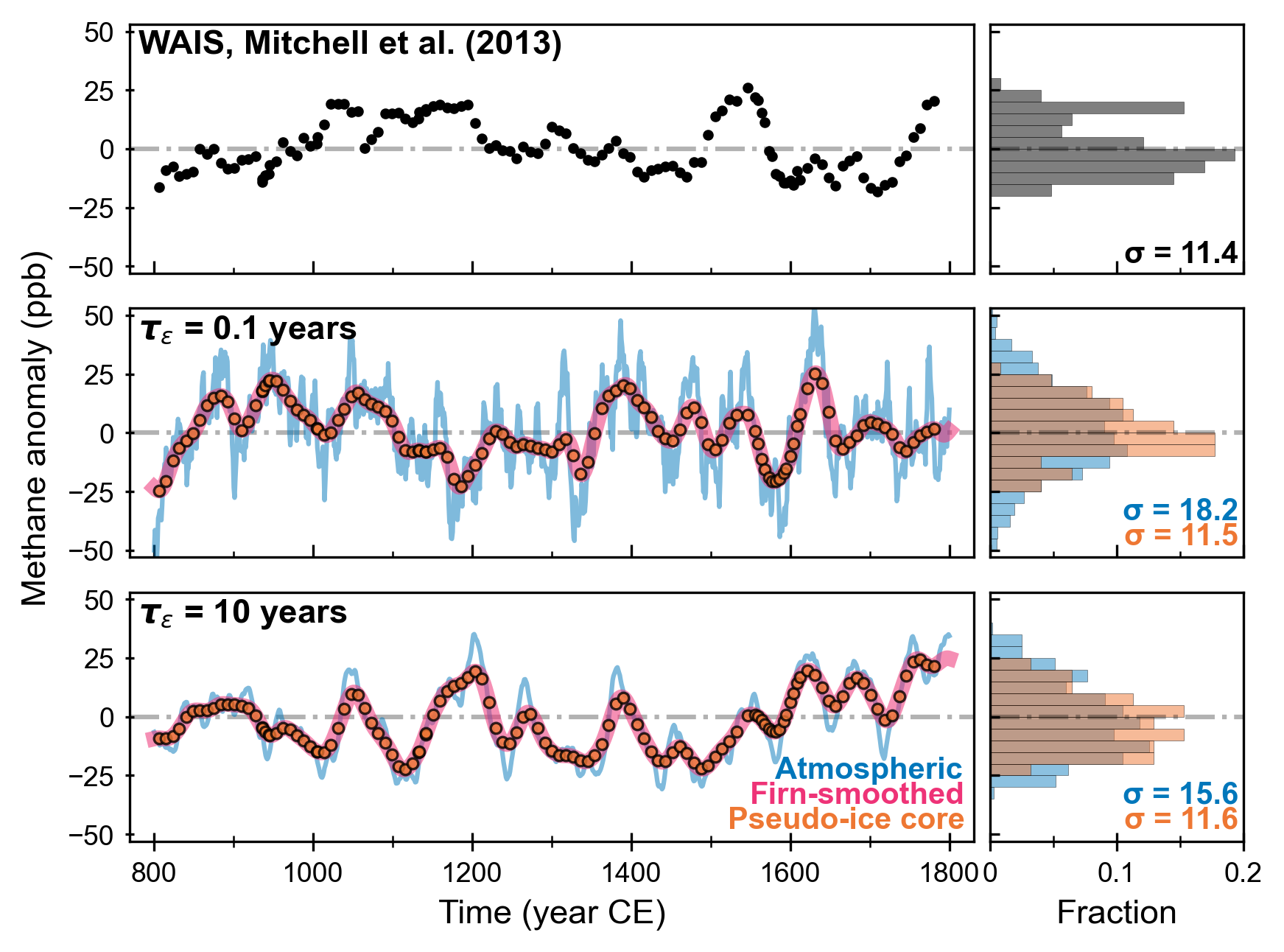
Ice core methane varies by ±5% on multi-decadal to centennial timescales. Although this has often been attributed to slow changes in climate or human actions, we use a simple methane model (see pub. [8]) to show that random, short-timescale fluctuations in sources and sinks are sufficient to reproduce the ice core record once we account for the smoothing effects of the methane lifetime and firn processes. If fast variations explain the ice core record, natural preindustrial variability could be large enough to explain modern interannual methane growth rate variability.
Chemistry-Climate Emulators
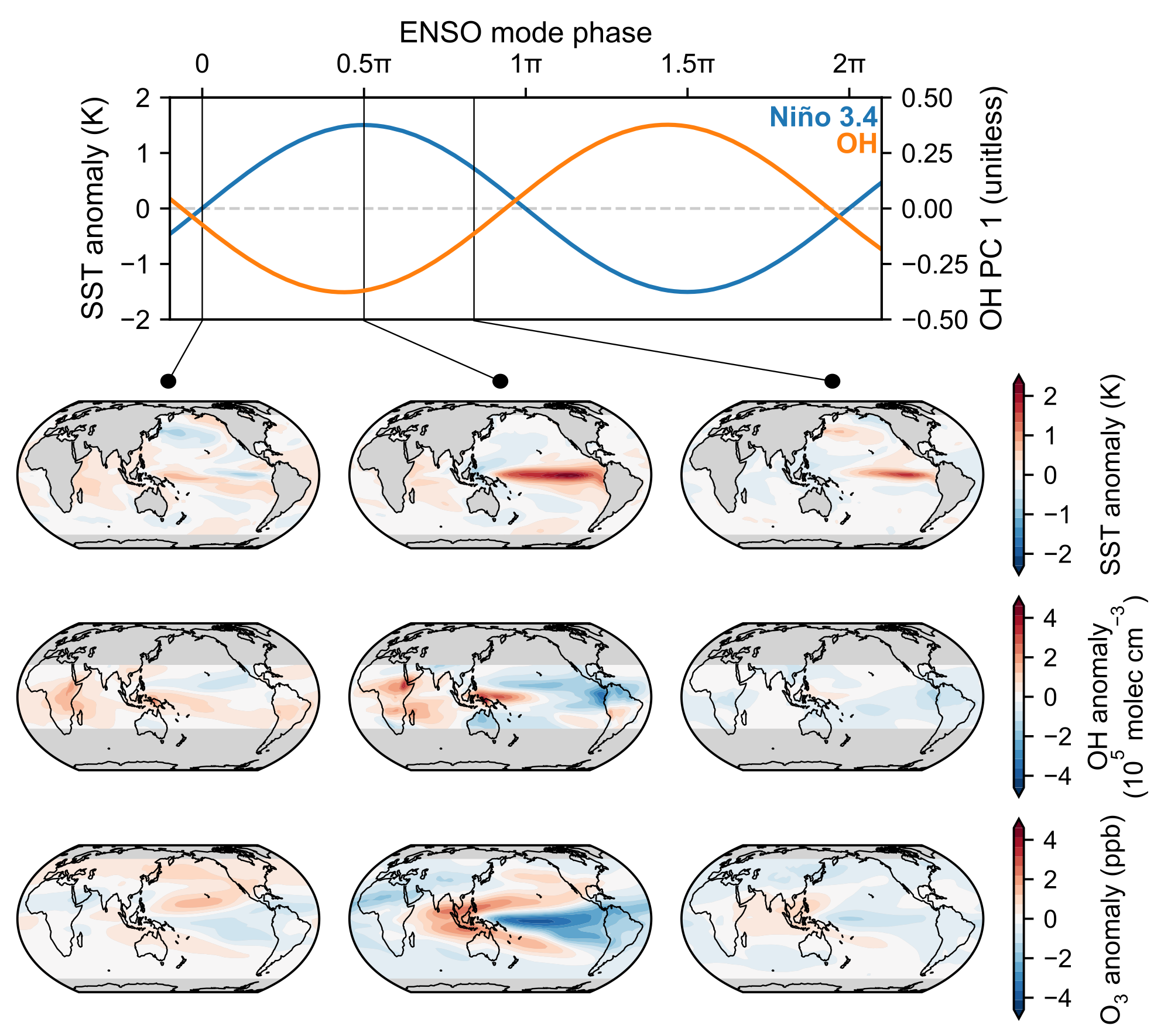
Chemistry–climate models (CCMs) capture complex interactions between dynamics, radiation, and atmospheric chemistry, but their computational cost limits how thoroughly they can be analyzed. We build data-driven linear inverse models (LIMs; see pub. [7]) that emulate these CCMs and reproduce their key modes of variability at very low cost. These emulators can skillfully forecast chemical fields months to a year ahead and provide a fast, physically grounded way to test hypotheses about chemistry–climate coupling that would otherwise require thousands of hours of supercomputing time.
Past Projects
I received a bachelor's and master's degree in environmental engineering from Georgia Tech. My previous research focused on air pollution, in which I investigated local concentrations of hazardous air pollutants (see pubs. [2], [3]) and impacts of regional air pollution control regulations (see pubs. [4], [5], [6]).